
- Some everyday lubricants reduced sperm motility in lab tests; Pre-Seed did not differ from the control in one study.
- In a cohort of 6,467 women, lubricant use was not linked with lower chances of conceiving.
- The FDA has a category called PEB for lubricants that are compatible with sperm, eggs and embryos.
- Fertility-friendly products tend to be closer to the body's own osmolality and pH.
- Never use oils or saliva as a stand-in if you are trying to conceive; check the label.
If you are trying for a baby, you may wonder whether the lubricant you used before is still a good idea, or whether a fertility-friendly lube is worth choosing instead. The honest answer is that the research is mixed. Laboratory studies show some products affect sperm movement, while a large real-world study found no sign that lubricant users took longer to conceive.
Here is what we know, what the FDA category means and how to pick a sperm-friendly lubricant made for the job when you are trying to conceive (TTC). If you have been trying for a year (or six months if over 35) without success, speak with a clinician.
Does lube kill sperm? What the lab studies found
In a 2008 study, researchers exposed donor sperm to 10% lubricant for 30 minutes. Progressive motility with Pre-Seed did not differ from control, while FemGlide, Replens and Astroglide significantly reduced sperm motility. FemGlide and K-Y Jelly also worsened sperm chromatin (DNA) quality. The lubricants were supplied by the maker of Pre-Seed.
A 2014 in vitro study tested 9 lubricants for 30 minutes at body temperature. Pre-Seed had the highest progressive motility (86%) and vitality (92%), Sylk the lowest motility (31%) and Forelife the lowest vitality (28%).
Progressive sperm motility after 30 minutes (in vitro)
Selected products; lab conditions differ from real life
What a large real-world study found
A prospective cohort of 6,467 women in Denmark and North America asked whether lubricant use changed time to pregnancy. It did not. Fecundability ratios, where 1.0 means no change, were 1.02 for water-based products that are not pH-balanced, 1.01 for fertility-friendly products, 1.23 for oil-based and 1.27 for silicone, and all confidence intervals included 1.
So the lab findings were not borne out in real-world time to conception. Many couples still prefer a fertility-friendly product for peace of mind.
What does fertility-friendly lube mean?
In the US, the FDA has product code PEB, Lubricant, Personal, Gamete, Fertilization, and Embryo Compatible. It is a Class II device under 21 CFR 884.5300, requires a 510(k) clearance, and is defined as compatible with sperm, oocytes and embryos and usable by couples trying to conceive. The first clearance was PRE' Vaginal Lubricant (2006), followed by Conceive Plus (2013), Astroglide TTC (2015) and BabyDance (2017). There are 10 clearances in total. When a pack says FDA cleared for conception use, this is the category it refers to.
| Feature | Fertility-friendly | Standard lube |
|---|---|---|
| Made and cleared for sperm compatibility | ✓ Yes (FDA PEB) | ✗ Not required |
| Typical osmolality | ~ Maker-stated, often lower | ✗ Often several thousand mOsm/kg |
| pH-balanced to vaginal pH | ✓ Usually stated | ~ Varies |
| Pre-filled applicators | ✓ Some products | ✗ Rare |
| Latex condom use at the same time | ~ Not the aim | ✓ Usually |
Source: FDA product classification PEB
Osmolality, pH and why they come up
Fertility-friendly products are usually described in terms of osmolality and pH, because sperm and vaginal tissue are sensitive to both. Vaginal secretions measure about 260 to 290 mOsm/kg and semen 250 to 380 mOsm/kg. WHO's ideal upper limit for a lubricant is 380 mOsm/kg, but WHO also notes that most commercial lubricants are 2,000 to 6,000. In one study, two gels that were nearly iso-osmolar were Good Clean Love (269) and PRÉ (502).
Pre-Seed describes itself as isotonic and pH-balanced, and Good Clean Love describes Regenesis as bio-matching natural vaginal moisture. Those are maker statements, so look for the numbers on the pack or the company's website. Our osmolality guide shows how typical gels compare.
Products to consider
From the makers' descriptions:
- Pre-Seed Fertility Lubricant is described as isotonic and pH-balanced like the vaginal environment, developed by doctors and used by fertility clinics, with applicators included.
- Pre-Seed pre-filled applicators are single-use for convenience.
- Good Clean Love Regenesis is a water-based, hydroxyethylcellulose formula with calcium and magnesium ions, described as not decreasing sperm motility and as safe for toys.
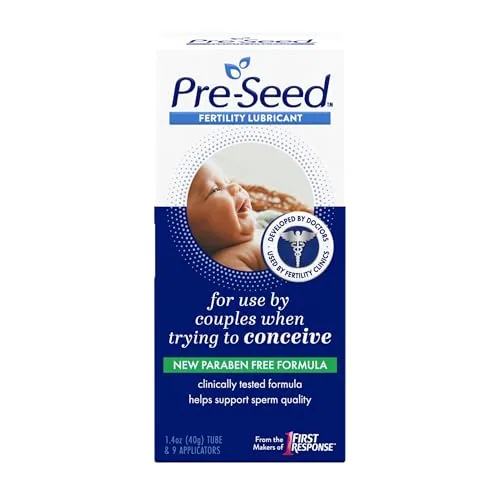
Pre-Seed Fertility Lubricant, 9 Applicators
- Fertility-friendly
- Isotonic, pH balanced
- Prefilled applicators
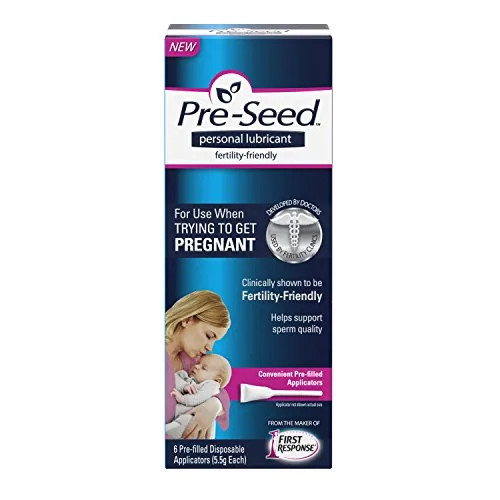
Pre-Seed Fertility-Friendly Lube Applicators
- Fertility-friendly
- Isotonic, pH balanced
- Prefilled applicators
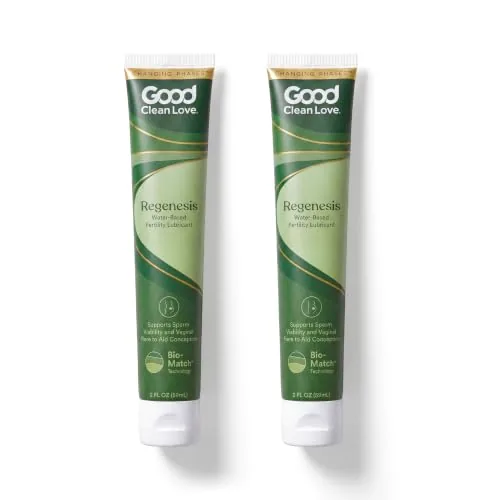
Good Clean Love Regenesis Fertility Lube, 2 oz (2-pack)
- Fertility friendly
- Glycerin & paraben free
- Fragrance free
Browse the fertility-friendly category and our Pre-Seed and Good Clean Love pages.
Timing, comfort and a calm mindset
Trying to conceive can turn intimacy into a schedule, and comfort matters. Dryness or discomfort can make sex less enjoyable, and a little lubricant can help the mood stay light. Some couples use applicators so lubricant is placed before intimacy and does not interrupt the moment.
If you are tracking ovulation, remember that fertile cervical mucus is itself a natural lubricant, so you may need less around the fertile window. Stress, sleep and general health also play a part, and no lubricant can replace a conversation with a clinician if conception is taking longer than expected.
Partners who are worried about sperm quality can also see a clinician. Lifestyle factors, medications and medical conditions are bigger drivers of fertility than lubricant choice for most couples.
Practical tips
- Use as little as you need, since even gentle formulas are not the same as cervical mucus.
- Avoid oils, saliva and household substitutes.
- If you use condoms outside fertile windows, a different lubricant for those times is fine.
- Talk to your clinician if you have been trying for a year, or sooner in specific situations.
For general guidance see how to choose a lubricant and osmolality and pH explained.
Questions
Does regular lube make it harder to get pregnant?
In a large cohort of 6,467 women, lubricant use was not associated with reduced fecundability. Lab studies do show some products can affect sperm, so many couples choose a fertility-friendly option.
What is the FDA category for fertility lubricants?
Product code PEB, Gamete, Fertilization, and Embryo Compatible, a Class II device requiring 510(k) clearance.
Can I use oil or coconut oil when trying to conceive?
It is better to avoid it. Oils are not condom-safe with latex and are not designed or tested as sperm-compatible lubricants.
Do I need to use lube at all?
No. If you need it for comfort, choose a fertility-friendly product and use a small amount.
What is fertility-friendly lube?
It is a lubricant made to be compatible with sperm, eggs and embryos. In the US, such products are cleared by the FDA under product code PEB, so look for that wording on the pack.
Does lube kill sperm?
Some lubricants reduced sperm motility in lab studies, but a large cohort of 6,467 women found no link between lubricant use and time to pregnancy. A fertility-friendly lube is a sensible precaution rather than a requirement.